
Today, we’re excited to announce Clink’s partnership with Visa to bring Visa Intelligent Commerce to Clink Wallet.
AI agents can already help people search, compare, and decide what to buy. The next step is enabling them to complete a purchase—without asking users to hand over their card details or give an agent open-ended spending access.
Together, Clink and Visa are creating a simpler, safer way for AI agents to pay on a user’s behalf—building on Clink Agentic Payments, our payment infrastructure for the agent economy.
Visa brings the global payment network, tokenization, authentication, and intelligent controls behind Visa Intelligent Commerce. Clink brings the wallet, user authorization experience, and developer infrastructure that connect those capabilities to AI agents.
A safer way for agents to pay
Payments were designed for people entering card details at checkout. AI agents work differently. They may search across merchants, compare options, and determine the final price only after the user has given them a task.
Clink Wallet turns that task into clear payment authority. The agent does not need unrestricted access to the user’s card. Its authority is tied to the purchase the user approved.
Visa Intelligent Commerce for an agent wallet
Visa Intelligent Commerce is Visa’s portfolio for trusted AI-initiated transactions. It brings together agent-specific payment tokens, authenticated payment instructions, transaction controls, and commerce signals so an AI agent can pay on a user’s behalf while the user’s original intent remains part of the payment context.
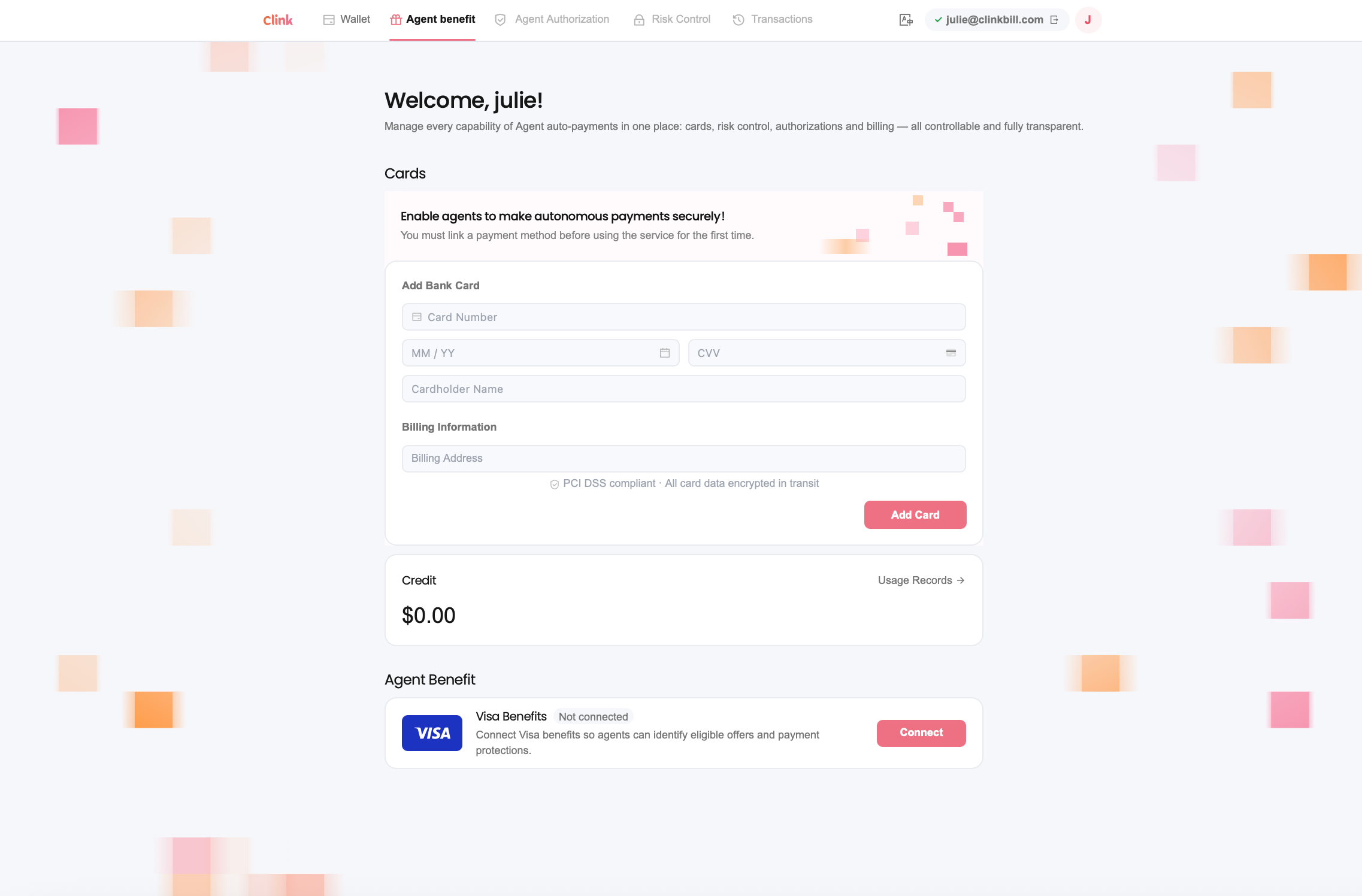
An agent wallet is the user-facing layer that connects a payment method with agent identity, spending authority, and transaction visibility. Clink Wallet gives users one place to connect a Visa card, authorize an agent, set risk controls, and review what happened. Visa Intelligent Commerce connects that wallet experience to network-level tokenization and payment controls.
From intent to payment
Connect a Visa card
The user links a card to Clink Wallet. The underlying card details remain protected through tokenization.
Authorize the purchase
The user defines what the agent may buy, how much it may spend, and how long the authorization remains valid.
Complete the task
At checkout, the agent requests payment access for that specific purchase—not a reusable card credential.
Process and record
The payment moves through Visa’s network, and Clink keeps the result visible to the user.
From an agent wallet to real merchant checkout
Agentic payment only becomes useful when an agent can reach a real product, create an order, complete payment, and return a result to the task. Clink connects the wallet and authorization layer to merchant commerce across three product surfaces already supported today.
Shopify, globally
Agents can discover products and complete supported checkout flows across Shopify storefronts globally, while merchants keep their existing storefront and fulfillment workflow.
APAC offline pickup
For selected coffee and food partners in APAC, agents can choose a store, place an order, and return a pickup code or order status to the user.
Token and tool usage
Agents can pay for API products—including model token consumption and paid agent tools—so a task can keep running when it reaches a paid capability.
For merchants, Clink turns product discovery, order creation, payment, and task-ready status into a flow an agent can call. For agent builders, the same wallet can move from a Shopify purchase to a coffee pickup or an API top-up without rebuilding the payment layer for each merchant type.
What Clink and Visa bring together
Visa Intelligent Commerce is designed to give AI-driven transactions the trust, identity, and payment controls they need to operate at scale. Clink makes those capabilities accessible through one wallet for users and one integration for agent developers.

Global payment infrastructure, Visa Token Service, authentication, and intelligent transaction controls.

A user-controlled wallet, agent authorizations, risk controls, transaction visibility, and one developer integration.
For developers, Clink provides a payment layer they can add to an agent without rebuilding card enrollment, authentication, tokenization, transaction controls, and payment reporting. Developers can start with the Clink API documentation.
A wallet for the agent economy
We believe people should be able to use one wallet across many AI agents—not create a new payment setup for every agent they try. That requires agent-native payment rails designed around delegated authority rather than a traditional human checkout session.
With Clink Wallet, users connect a card once and choose which agents can use it. Each agent has its own permissions. Each purchase has its own authorization. Every transaction remains visible in one place.
This partnership combines Visa’s trusted payment infrastructure with Clink’s agent-native wallet experience. It gives AI agents a practical path from helping someone make a decision to completing the payment—with the user still in control.
Build the next payment interface with us.
If you are building an AI agent that needs to transact on behalf of users, install the Clink Payment Skill or explore Clink Agentic Payments.

Co-founder at Clink. Building global payments for humans and agents.